EKS · AKS · GKE
One schema, three clouds
Provider differences are resolved at ingest. A node is a node whether it came from an Auto Scaling group, a VM scale set, or a managed instance group, so comparisons across clouds actually hold.
Cloud Dongle traces spend across AWS, Azure, and GCP down to the individual pod — so the money you can reclaim stops being a guess and starts having a name.
Read-only access · nothing changes without your approval
A cloud invoice is a sum. Cloud Dongle reads your AWS, Azure, and GCP estates read-only and normalises every cluster, node, and pod into one schema — so spend stops being a total and becomes a list of named things.
Provider differences are resolved at ingest. A node is a node whether it came from an Auto Scaling group, a VM scale set, or a managed instance group, so comparisons across clouds actually hold.
It reads. It never writes, never schedules, never evicts. There is no permission in the integration that could take production down, which is what makes the security review short.
Cost lands on the pod and namespace that incurred it, not on an account-level bucket you then have to divide by hand.
A dashboard hands you the metrics and leaves the judgement to you. Cloud Dongle scores every finding by dollar impact and blast radius, then writes the advisory: what to change, what it saves, what it risks. The model output is the product.
Per-customer time-series models learn what normal load and spend look like for that estate specifically, so a deviation means something for them rather than tripping a generic threshold.
Projects forward cost alongside the optimised counterfactual — the bill you are heading for, next to the bill you could have.
Recommends CPU and memory targets per workload from observed utilisation, not from the request values someone guessed at during the first deploy.
Ranks security findings by exploitability and blast radius. A vulnerability behind a public ingress is not the same finding as the same CVE on an internal-only service.
Natural-language questions over the estate, answered with the number and the cluster it came from — not a link to a dashboard you then have to read.
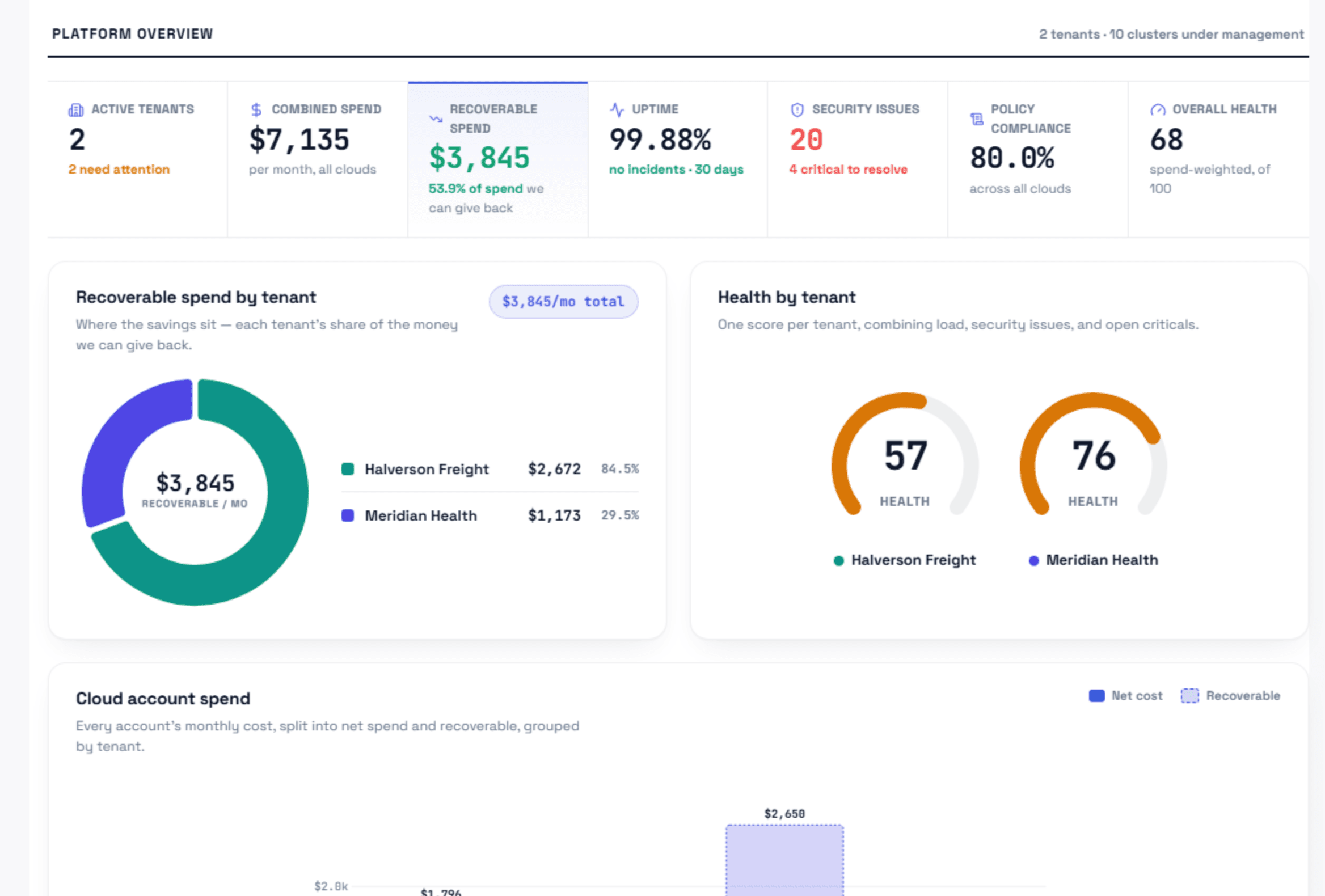
$7,135
combined monthly spend across 2 tenants
Halverson Freight runs $3,160 and Meridian Health $3,975 a month. Halverson is the smaller estate but the more wasteful one — most of its spend is recoverable, while Meridian's is largely committed to workloads that are actually using what they request.
10 clusters · AWS, Azure and GCP · demo estate
Most tools sort findings by severity label and hand you a list nobody can finish. Cloud Dongle ranks by what a finding actually costs you — reachability, blast radius, and dollars — so the critical tier stays small enough to clear.
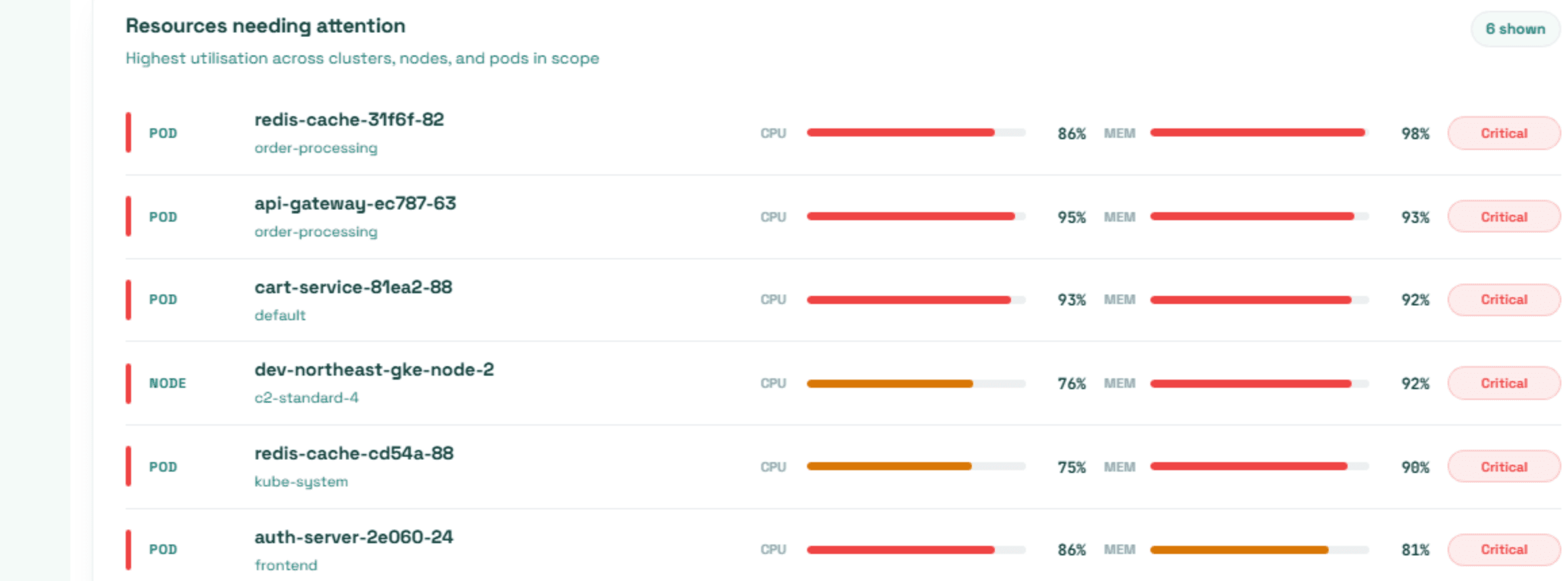
A single triage feed across clusters, nodes, and pods, sorted by real utilisation pressure rather than by which check fired most recently.
Criticals are the rarest tier by construction. A wall of red teaches teams to ignore red, so the thresholds are tuned to keep the top of the pyramid narrow.
A vulnerability behind a public ingress and the same vulnerability on an internal-only service are not the same finding, and are not ranked as though they were.
Not ninety panels of telemetry. Six questions a budget owner actually asks, answered in plain language and traceable to the workload underneath. Hover any signal to see how it's derived.
Uptime
99.88%
No incidents · last 30 days
Derived from each cluster’s health status, never asserted. A degraded cluster mathematically cannot report 99.99%.
Recoverable spend
$3,845/mo
Waste we can give back
Summed from costed advisories, not a percentage guess. Every dollar traces to a specific workload you can act on.
Security issues
20
4 critical to resolve
Ranked by blast radius and reachability rather than raw CVSS, so the critical tier stays small enough to actually clear.
Policy compliance
80.0%
Across AWS · Azure · GCP
One governance score spanning AWS IAM, Azure RBAC, and GCP service accounts — read in a single place.
Resource utilization
64%
Average across clusters
Requested versus actually consumed CPU and memory. The gap between those two numbers is where the recoverable spend lives.
Overall health
68/100
Needs attention
One composite of load, availability, and open criticals — computed identically for a tenant and for the fleet, so the numbers reconcile.
AWS IAM, Azure RBAC, and GCP service accounts each have their own vocabulary for the same ideas. Governance is read in one place, in one language, with availability derived from cluster health rather than asserted.
Rolling 30-day uptime is computed from each cluster’s health status. A degraded cluster mathematically cannot report 99.99%, which is what makes the number worth showing a customer.
A single governance reading spanning all three providers, with the underlying findings one click away rather than buried in three consoles.
Each item carries what was observed and when, so a remediation conversation starts from the same facts instead of from a screenshot.
Managed service providers and platform teams need one console that shows every customer at once and a per-customer view that reveals nothing about the others. Both come standard, fully white-labeled.
The platform overview and each tenant dashboard compute health from the same formula, so a number never changes meaning depending on which screen you are looking at.
A customer admin sees only their own accounts. The tenant filter is enforced on the data, not hidden in the interface.
Brand name, logo, tagline, and palette are per-tenant. Resell it as your own product; the charts recolour with the theme.
A flat per-cluster rate you can forecast, and a wholesale arrangement for partners who resell it. No per-gigabyte ingest meter that punishes you for having good observability.
For teams running a handful of clusters across one or two clouds.
$99
per cluster / month
The full decision engine for a platform team that owns the budget.
$149
per cluster / month
For providers reselling Cloud Dongle to their own customers.
Wholesale
platform fee + per cluster
Start here
The sandbox runs on demo data, so you can look before you connect anything. When you are ready, access is read-only and nothing changes without your approval.
Built by Anto and Edwin · Jacav